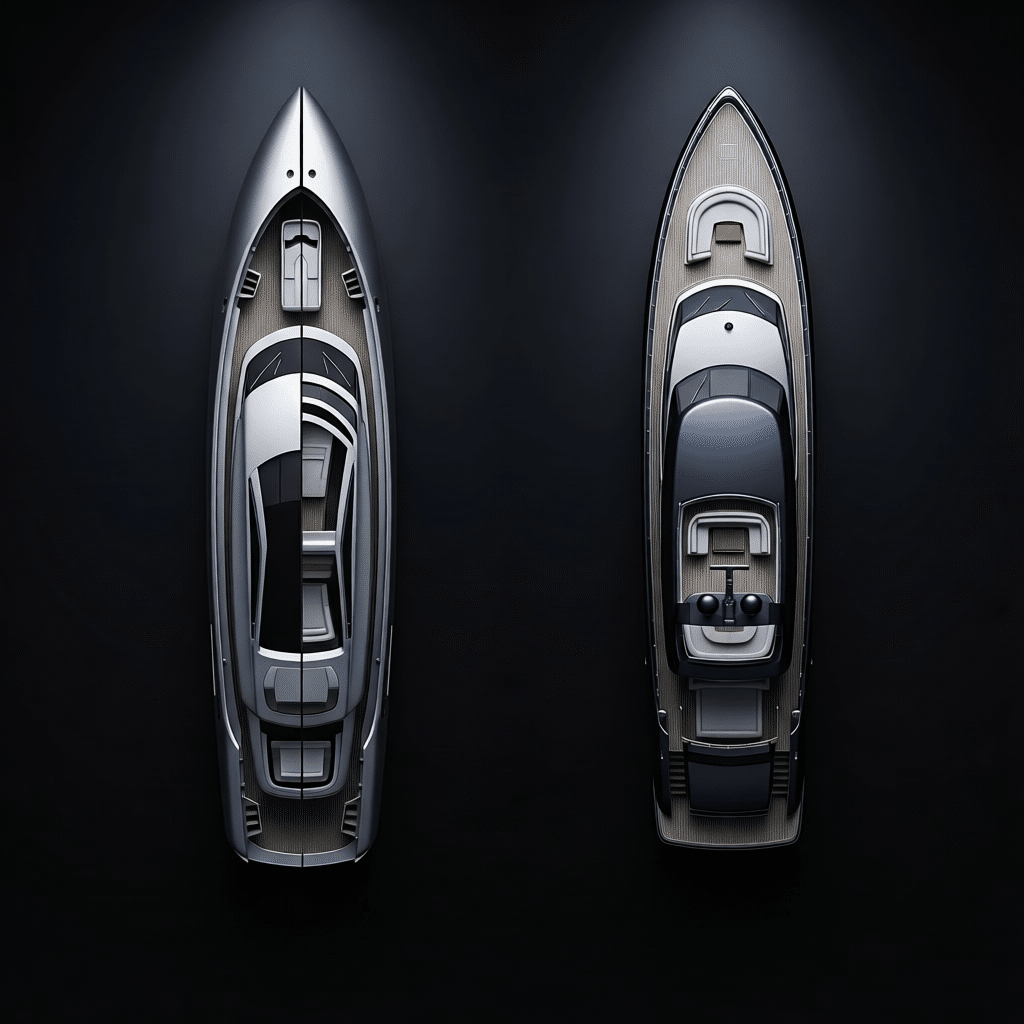



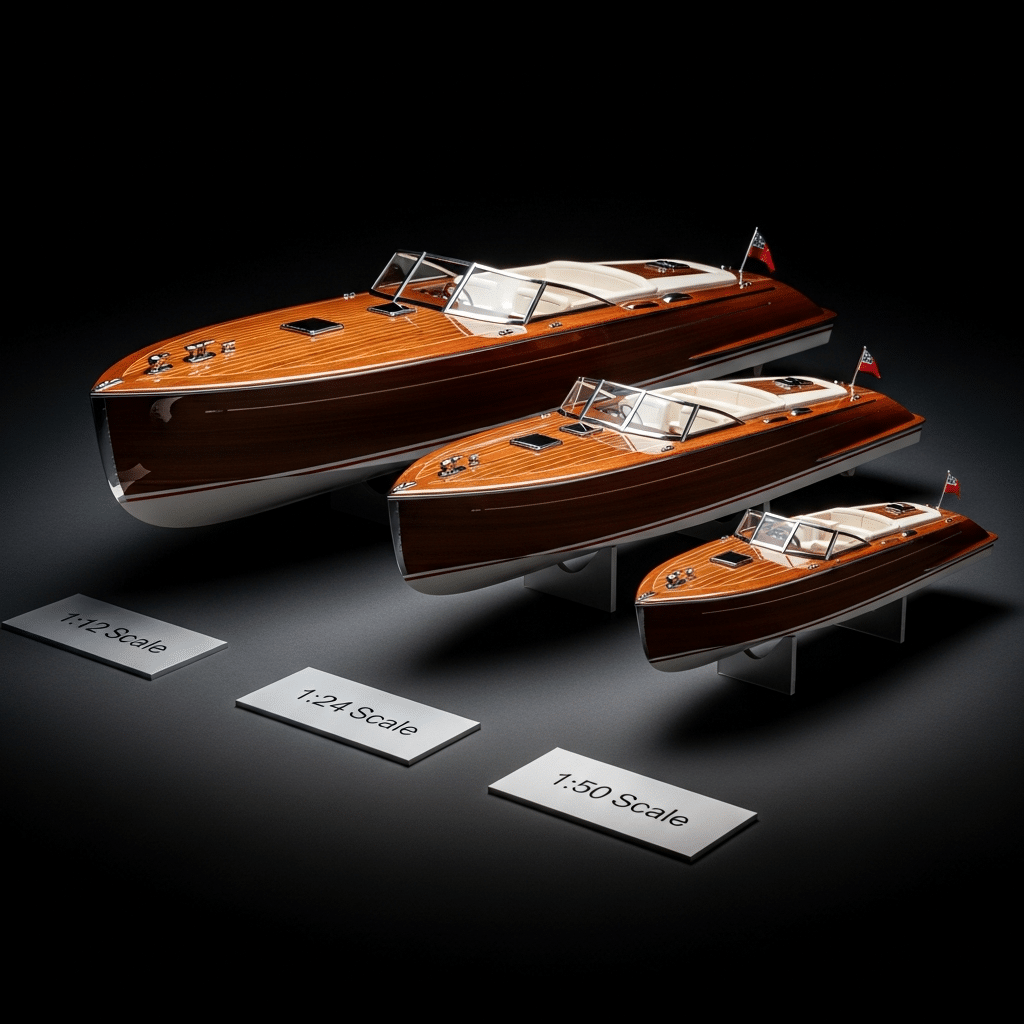
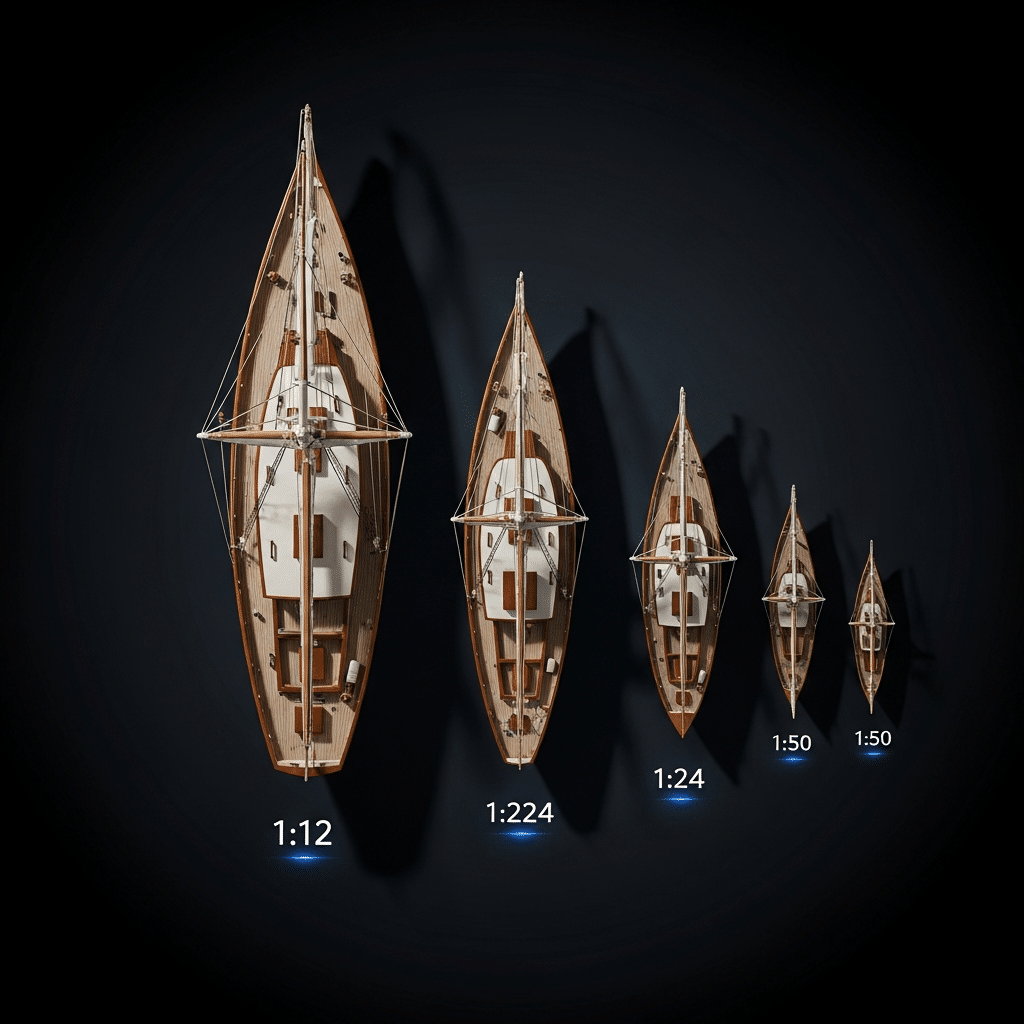
Boat model scales represent the proportional relationship between the model and the actual vessel, with common scales ranging from 1:12 (larger, highly detailed) to 1:50 (smaller, space-efficient). A 1:24 scale means one inch on the model equals 24 inches (two feet) on the real boat, resulting in a 40-foot yacht producing a 20-inch model—the most popular scale balancing detail visibility with manageable display size.
How Model Scales Work: The Mathematics
Understanding Scale Ratios
Scale notation uses a ratio format where the first number represents the model and the second represents the full-size vessel. The scale 1:24 means:
-
1 unit on the model = 24 units on the actual boat
-
1 inch model = 24 inches (2 feet) real boat
-
1 centimeter model = 24 centimeters real boat
This proportional relationship maintains accuracy across all dimensions—length, beam, height, and every detail from hull to superstructure.
Scale calculation examples:
A 36-foot sailboat at different scales:
-
1:12 scale: 36 feet ÷ 12 = 3 feet (36 inches) model length
-
1:24 scale: 36 feet ÷ 24 = 1.5 feet (18 inches) model length
-
1:32 scale: 36 feet ÷ 32 = 1.125 feet (13.5 inches) model length
-
1:48 scale: 36 feet ÷ 48 = 0.75 feet (9 inches) model length
The larger the second number in the ratio, the smaller the resulting model. This inverse relationship confuses newcomers but becomes intuitive with experience.
Imperial vs Metric Scale Standards
Model shipbuilding traditionally uses both Imperial and metric scale standards:
Common Imperial scales:
-
1:12 (1 inch = 1 foot)
-
1:24 (1/2 inch = 1 foot)
-
1:48 (1/4 inch = 1 foot)
-
1:96 (1/8 inch = 1 foot)
-
1:240 and 1:360 (for large ships)
Common metric scales:
-
1:10
-
1:20
-
1:25
-
1:50
-
1:100
-
1:200
Imperial scales derive from architectural drafting conventions where 1/4 inch equals one foot (1:48 scale) or 1/2 inch equals one foot (1:24 scale). These fractional relationships made manual drafting and calculation easier before digital tools.
Metric scales use decimal relationships—1:50 means one centimeter equals 50 centimeters (0.5 meters) on the full-size boat, providing straightforward calculations.
Popular Boat Model Scales
Large Scales: 1:12 to 1:20
Characteristics:
-
Exceptional detail capacity including miniature instruments, controls, and fittings
-
Substantial physical presence commanding attention
-
Require significant display space (24-60+ inches for typical yachts)
-
Higher investment due to material quantity and labor hours
-
Best for exhibition pieces, yacht club displays, and builder showrooms
Typical applications:
The 1:16 to 1:20 scale range excels for showcasing specific yacht features—complex deck layouts, innovative helm stations, or intricate rigging systems. A 40-foot center console at 1:16 scale produces a 30-inch model revealing every rod holder, livewell, and electronic display.
Detail capabilities at large scales:
-
Individual instruments on helm consoles legible and realistic
-
Functional-appearing hardware (cleats, winches, stanchions)
-
Upholstery texture and stitching visible
-
Rigging details including shackles, blocks, and fairleads
-
Underbody features like through-hulls, transducers, and zincs
Large scale models suit clients prioritizing visual impact over space constraints. Corporate lobbies, yacht club trophy rooms, and maritime museum exhibits benefit from the commanding presence these scales provide.
Size examples at 1:16 scale:
-
30-foot boat = 22.5 inches LOA
-
40-foot boat = 30 inches LOA
-
50-foot boat = 37.5 inches LOA
-
60-foot boat = 45 inches LOA
Medium Scales: 1:24 to 1:32
The sweet spot for custom boat models:
These scales balance detail, size, and cost, making them the most requested for custom boat models and half hull models.
1:24 Scale advantages:
-
Fits standard residential and office display spaces
-
Sufficient size for impressive detail work
-
Manageable investment for most budgets
-
Popular scale allowing comparison with other models
-
Half hulls at this scale: 15-24 inches for typical yachts
1:32 Scale benefits:
-
More compact while retaining good detail
-
Lower material and labor costs than 1:24
-
Suitable for multiple-model collections
-
Common scale for ready-made ship models
-
Half hulls at this scale: 12-18 inches for typical yachts
Detail capabilities at medium scales:
Medium scales accommodate substantial detail without requiring magnification to appreciate. Deck hardware, cabin details, and rigging elements are clearly visible from normal viewing distances (3-6 feet).
Visible details include:
-
Deck cleats, winches, and stanchions accurately shaped
-
Helm station layouts with instrument panels
-
Hatch covers, grab rails, and safety equipment
-
Running lights and navigation equipment
-
Canvas work including biminis and dodgers
-
Proper scale rigging for sailing vessels
Size examples at 1:24 scale:
-
30-foot boat = 15 inches LOA
-
40-foot boat = 20 inches LOA
-
50-foot boat = 25 inches LOA
-
60-foot boat = 30 inches LOA
Size examples at 1:32 scale:
-
30-foot boat = 11.25 inches LOA
-
40-foot boat = 15 inches LOA
-
50-foot boat = 18.75 inches LOA
-
60-foot boat = 22.5 inches LOA
This scale range dominates the custom sailboat models and custom powerboat models categories at Abordage.
Smaller Scales: 1:40 to 1:50
Characteristics:
-
Compact dimensions suitable for limited spaces
-
Lower investment point for budget-conscious clients
-
Good proportions but limited fine detail
-
Excellent for fleet collections or multiple vessels
-
Desk models at these scales: 8-15 inches typical
Applications:
Smaller scales work well for desk model collections where multiple boats are displayed together, documenting yacht ownership history or a designer’s portfolio.
Detail limitations:
-
Individual deck fittings simplified or represented symbolically
-
Rigging lines heavier than exact scale to maintain visibility
-
Instrumentation suggested rather than precisely detailed
-
Graphics and lettering approaching minimum legibility
Advantages:
-
Multiple models fit standard shelves or credenza tops
-
Protective cases more affordable due to smaller size
-
Shipping costs lower with reduced dimensions
-
Faster production timelines due to less detail work
Size examples at 1:48 scale:
-
30-foot boat = 7.5 inches LOA
-
40-foot boat = 10 inches LOA
-
50-foot boat = 12.5 inches LOA
-
60-foot boat = 15 inches LOA
The fine ship models collection includes many ready-to-ship options in 1:50 to 1:80 scales, making them accessible entry points for maritime model collecting.
Very Small Scales: 1:80 to 1:100
Specialized applications:
-
Very large vessels (superyachts 150+ feet, commercial ships)
-
Historical warships and tall ships with complex rigging
-
Fleet displays representing multiple vessels
-
Budget-conscious options for impressive subjects
-
Model lengths typically 12-24 inches for large subjects
Considerations:
These scales sacrifice detail for manageable representation of very large subjects. A 200-foot superyacht at 1:100 scale produces a 24-inch model—impressive yet displayable.
Detail work at these scales requires exceptional craftsmanship. Individual fittings become symbolic representations rather than miniature replicas. However, overall proportions, hull lines, and superstructure arrangements remain accurate.
Choosing the Right Scale for Your Project
Space Considerations
Measure your display location before selecting scale:
| Display Location | Recommended Scales | Model Size Range |
|---|---|---|
| Desk or credenza top | 1:40 – 1:50 | 8-15 inches |
| Bookshelf or cabinet | 1:32 – 1:48 | 10-20 inches |
| Office wall (half hull) | 1:24 – 1:32 | 12-24 inches |
| Living room wall | 1:20 – 1:24 | 18-36 inches |
| Yacht club trophy room | 1:16 – 1:24 | 24-48 inches |
| Corporate lobby | 1:12 – 1:20 | 36-60+ inches |
Allow 6-8 inches of clearance around models for proper visual breathing room. Crowded displays diminish individual model impact.
Half hull wall displays:
Half hull models mounted on backboards require wall space 4-6 inches wider and taller than the model itself. A 20-inch half hull needs approximately 24-26 inches of horizontal wall space.
Consider viewing distance when selecting wall display scales. Models viewed from across a room (10+ feet) can be smaller scale than those viewed close-up in an office or hallway setting.
Budget Factors
Scale directly impacts investment level:
Price relationship to scale:
-
Larger scales use more materials (wood, brass, paint)
-
Detail work requires additional craftsman hours
-
Complex rigging systems multiply labor time
-
Larger display cases cost more
Approximate investment ranges:
Half hull models:
-
1:48 scale (10-14″): $800-$1,500
-
1:32 scale (14-20″): $1,200-$2,200
-
1:24 scale (18-28″): $1,800-$3,500
-
1:16 scale (28-42″): $3,500-$6,000+
Full desk models:
-
1:50 scale (8-15″): $1,800-$3,000
-
1:40 scale (12-20″): $2,500-$4,500
-
1:32 scale (15-24″): $3,500-$6,500
-
1:24 scale (20-36″): $5,000-$12,000+
These ranges vary based on boat complexity, detail level requested, and construction style. Simple hull shapes cost less than multi-hull designs or complex powerboat configurations.
Subject Matter Considerations
Boat type influences optimal scale:
Small boats (under 25 feet):
-
Dinghies, daysailers, small powerboats
-
Recommended scales: 1:16 to 1:24
-
Smaller scales produce tiny models lacking presence
-
Example: 20-foot daysailer at 1:20 = 12-inch model
Medium boats (25-45 feet):
-
Cruising sailboats, sportfishing boats, small yachts
-
Recommended scales: 1:24 to 1:32
-
Sweet spot for detail and size
-
Example: 36-foot sailboat at 1:24 = 18-inch model
Large yachts (45-80 feet):
-
Offshore cruising yachts, sportfish, motoryachts
-
Recommended scales: 1:32 to 1:48
-
Prevents excessively large models
-
Example: 60-foot yacht at 1:32 = 22.5-inch model
Superyachts (80+ feet):
-
Luxury megayachts and sailing superyachts
-
Recommended scales: 1:50 to 1:100
-
Manages size while retaining presence
-
Example: 150-foot superyacht at 1:80 = 22.5-inch model
Historic ships (tall ships, warships):
-
Variable based on vessel size and rigging complexity
-
Common scales: 1:48 to 1:100
-
Balance rigging details with manageable size
-
Example: 200-foot clipper at 1:96 = 25-inch model
The manufacturers section shows various boat types at appropriate scales for reference.
Detail Priority
Determine what aspects of your vessel matter most:
Hull form emphasis:
-
Half hull models showcase lines beautifully at any scale
-
Larger scales (1:16-1:24) reveal subtle hull shapes better
-
Racing yacht underbodies benefit from larger scales
-
Classic designs with graceful sheers read well even smaller
Deck layout importance:
-
Complex cockpits and helm stations require 1:24 or larger
-
Simple deck arrangements work at 1:32-1:40
-
Center console boats need sufficient scale for console details
-
Flybridge layouts benefit from larger scales showing levels
Rigging details (sailing vessels):
-
Full standing and running rigging requires 1:24 minimum
-
Simplified rigging acceptable at 1:32-1:40
-
Very small scales (1:50+) use symbolic rigging
-
Classic tall ships need 1:48-1:96 balancing rigging with size
Custom features:
-
Unique modifications or custom equipment require larger scales
-
Standard production boat configurations work at any scale
-
Graphic schemes and lettering need sufficient size for clarity
-
Special paint schemes and artwork benefit from larger scales
Discuss priorities with your model builder to select appropriate scale. The custom model request form guides you through these considerations.
Scale Consistency in Collections
Building Coherent Collections
Collectors documenting yacht ownership history or assembling designer portfolios face scale selection decisions:
Single scale approach:
-
All models built to same scale (typically 1:24 or 1:32)
-
Creates visual coherence across display
-
Accurately shows relative size differences between boats
-
Simplifies display case and shelving planning
Advantages:
-
Professional, museum-quality appearance
-
Easy comparison between different designs
-
Unified aesthetic across collection
-
Display furniture standardized
Challenges:
-
Very small boats produce tiny models
-
Very large boats create oversized models
-
May require compromise on detail level
-
Display space varies significantly per model
Variable scale approach:
-
Each boat modeled at optimal scale for its size
-
All models finish approximately same physical size (e.g., 18-24″)
-
Maximizes detail on each individual model
-
Better uses available display space
Advantages:
-
Every model commands similar visual presence
-
Small boats get larger scales showing more detail
-
Large boats avoid excessive dimensions
-
Display consistency in physical footprint
Challenges:
-
Doesn’t accurately represent relative size differences
-
Less coherent from collecting/archival perspective
-
Requires explaining scale differences to viewers
The custom models section accommodates either approach based on your collection goals.
Documentation and Presentation
Label models clearly with scale information:
-
Engraved brass plaques on bases or backboards
-
Include: boat name, LOA, scale, year
-
Helps viewers understand proportional relationships
-
Documents collection for insurance and provenance
Display strategies:
-
Group same-scale models together
-
Arrange chronologically or by type
-
Use consistent lighting across collection
-
Maintain similar backboard or base styles
Working with Custom Scales
Non-Standard Scale Requests
While standard scales (1:12, 1:16, 1:20, 1:24, 1:32, 1:40, 1:48, 1:50) dominate, custom scales accommodate specific requirements:
Space-driven custom scales:
-
“Make the model exactly 18 inches long”
-
Builder calculates resulting scale (e.g., 1:27 or 1:31)
-
Works when display space dictates model size
-
May produce odd-ratio scales
Matching existing models:
-
“Build to same scale as my current model”
-
Maintains collection consistency
-
Requires accurate measurement of reference model
Display case fitting:
-
“Model must fit this specific case”
-
Maximum dimensions drive scale selection
-
Common for presentation gifts with prepared cases
Custom scales may cost slightly more due to calculation complexity and lack of standardized jigs or patterns. However, Abordage accommodates these requests ensuring perfect fit for your needs.
Scale Verification
When commissioning, confirm:
-
Exact scale ratio (e.g., 1:24, not “approximately 1:24”)
-
Resulting model LOA in inches or centimeters
-
Beam, height, and draft measurements at chosen scale
-
How scale affects display case or mounting requirements
Request a dimensioned preview sketch showing model size before finalizing the commission.
Frequently Asked Questions
What’s the most popular scale for custom boat models?
Scale 1:24 dominates custom boat model commissions, balancing detail capacity, manageable size, and reasonable investment for vessels 25-60 feet LOA.
Can I commission different parts of my boat at different scales?
While technically possible, it creates visual confusion and isn’t recommended. Consistent scale across all elements maintains proportional accuracy and aesthetic integrity.
How does scale affect shipping fragility?
Larger scales generally ship more safely due to heavier construction and more robust components. Very small scales (1:50+) have delicate fittings more vulnerable to shipping damage, though professional packaging mitigates this.
What scale should I choose for a 30-foot sailboat?
Scale 1:20 produces a 18-inch model, 1:24 produces 15 inches, and 1:32 produces 11.25 inches. For a 30-foot boat, 1:20 or 1:24 provides optimal detail and presence without excessive size.